
Do you want more houseplants without spending extra money? The good news is—you can propagate your indoor plants at home. Plant propagation is the process of creating new plants from existing ones, and it’s surprisingly simple. With a few tools and a little patience, you can grow your indoor jungle for free.
This guide will walk you through the easiest propagation methods, perfect for beginners.
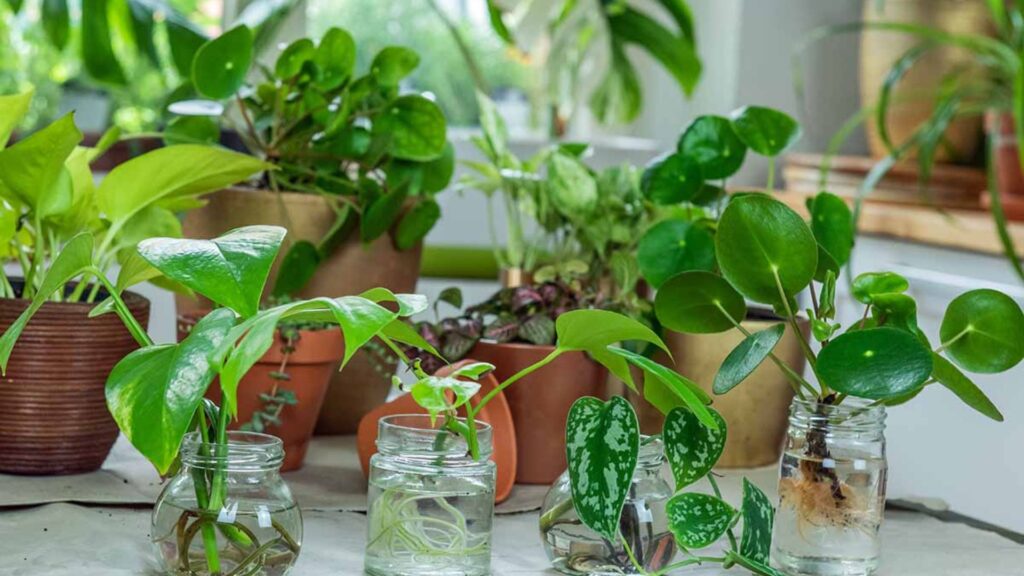
What Is Plant Propagation?
Plant propagation is how you reproduce plants from a parent plant. Indoor plants can be propagated through several methods, but the most common (and beginner-friendly) ones are:
-
Stem cuttings
-
Leaf cuttings
-
Division
-
Offsets or pups
Each method works best with certain types of plants. Let’s look at how to do each one step by step.
Stem Cutting Propagation
Best for: Pothos, Philodendron, Monstera, Tradescantia, and Coleus
Steps:
-
Choose a healthy stem with at least 2–3 leaves and a few nodes (the small bumps where roots grow).
-
Cut the stem just below a node using clean, sharp scissors or pruning shears.
-
Remove the lower leaves, leaving 1–2 at the top.
-
Place the cutting in water, making sure the nodes are submerged but the leaves are above water.
-
Put the jar in bright, indirect light and change the water every few days.
-
Wait for roots to grow (usually within 1–4 weeks). Once roots are 1–2 inches long, transplant into soil.
🌱 Tip: Use a clear glass jar so you can monitor root growth easily.
Leaf Cutting Propagation
Best for: Snake Plant, ZZ Plant, Begonia, and Peperomia
Steps:
-
Cut a healthy leaf from the parent plant.
-
For snake plants, cut the leaf into sections (about 3–4 inches long). Make sure to remember which end was the “bottom.”
-
Let the cuttings dry for a day or two to prevent rot.
-
Insert the cut end into soil (moist but not soggy).
-
Place in bright, indirect light and keep the soil lightly moist.
-
Roots will begin to form in 2–4 weeks.
🌿 Patience is key—leaf cuttings take longer than stem cuttings but are still very easy.
Division Propagation
Best for: Peace Lily, Spider Plant, Snake Plant, and Ferns
Division means splitting a mature plant into smaller plants, each with their own root system.
Steps:
-
Remove the plant from its pot and gently shake off excess soil.
-
Find natural separations—often, you’ll see the plant has grown in clumps.
-
Gently pull apart the clumps, or use a clean knife to divide the roots.
-
Replant each section in a new pot with fresh soil.
-
Water lightly and place in indirect sunlight.
🪴 This method gives you instant new plants and works especially well with fast growers.
Offsets and Pups Propagation
Best for: Aloe Vera, Haworthia, Bromeliads, and some Succulents
Some plants produce baby plants—called pups or offsets—around the base. These can be removed and grown on their own.
Steps:
-
Wait until pups are at least one-third the size of the parent plant.
-
Use a clean knife or twist gently to remove the pup, making sure it has some roots.
-
Let it dry for a day or two if it’s a succulent (to prevent rot).
-
Pot in well-draining soil and water lightly.
-
Place in indirect light and let the plant adjust.
🌞 Many succulent lovers grow entire collections this way—it’s simple and fun.
Tools You’ll Need
You don’t need much to get started. Here’s a basic propagation toolkit:
-
Clean scissors or pruning shears
-
Small pots or containers
-
Potting mix (or water jars for rooting)
-
Rooting hormone (optional, but can speed things up)
-
Labels (helpful if you’re propagating multiple plants)
Aftercare Tips
Once your cuttings are in soil or water:
-
Keep them in bright, indirect light
-
Avoid overwatering—moist, not soggy is key
-
Be patient—some plants root fast, while others take weeks
-
Don’t fertilize right away—wait until new growth appears
The more you propagate, the better you’ll understand each plant’s needs.
Conclusion
Propagating indoor plants is a simple, satisfying way to expand your green space. Whether you’re snipping a stem, dividing a root ball, or potting up a baby pup, each method brings the joy of watching something new grow.
Even if you’re a beginner, you can successfully propagate many common houseplants using just a few basic tools and techniques. Start with easy plants like pothos or spider plants, and soon you’ll have more greenery than you know what to do with!